Tuesday, June 30, 2015

ProtoIndoEuropean Dative Element -o

Accusative>Lative, Instrumental>Ablative


Accusative-Dative
Instrumental-Ablative
Sing.
Du.
Plur.
Sing.
Du.
Plur.
No Lative Element Acc-Ins
-m
-meh
-ns (<ms)
-bhi
-bhih
-bhis
Lative Element -o Lat-Abl
-mo
-ei
-moh
-mos
-bio
-bioh
-bhios
*Note: -ei would have been derived from the Locative form, and the -e- element may not have been -o- for whatever reason. Anatolian evidence, especially with regards to Hittite, is that the dative and locative endings were the same, though they had -a for the Allative (which may have been the origin of the Dative case elsewhere).
For Hittites Allative -a, its hard to tell whether or not this represents an -he element or an -o element, as it underwent the o>a shift. At least as far as we can tell from its transcription into cuneiform.
Hittite also as:
Ablative -az (-ats)
Instrumental -it

It's hard for me to say the origin of the Ablative ending, though its definitely not from the Genitive -as ending. The /ts/ element is often a result of ti>ts, like in -anti>-anza. Not sure if this is the result of the same change or not.

*Note: Accusative dual forms merged with Nominative dual forms, this may have always been this way; though the above postulation for a seperate accusative dual form is based on the dative dual forms, and is entirely speculation. As is the Ablative dual/plural forms (though Instrumental singular -mi forms are attested from Baltic and Slavic evidence).

Saturday, June 20, 2015

I've moved around Baltic, Slavic, Germanic, and Italic

I've redone some of how my site is organized, and subcategorized Baltic, Slavic, Germanic, Italic, and Celtic under Northwestern IndoEuropean.

Natlangs Old and Young: Northwestern IndoEuropean

Friday, May 29, 2015

The underrated significance of smaller dialects

As you already well know, all languages either have or will have lesser dialects. Dialectical differentiation is a part of the evolution of languages, always has been, and always will be. It just is.

To make things even better for the historical linguist, all languages today are descended from prior dialects of previous languages, sometimes several dialects at a time. Sometimes, two languages may "combine" to form a new language. We can discuss creoles and pigins another day....

In the earlier history of english, there were many instances where Old English dialects contributed different things to what became Middle English, and on from dialects of Middle English into Modern. Just as an example. Sometimes, two dialects can produce different outcomes, and sometimes both outcomes will survive in a common dialect. Like is with the pronunciation of "bury" after the vowel shifts.

It's kinda a perfect example, though not really, since by now the different pronunciations are still so similar that most don't even notice it. Though they may also only sound similar to my english ears, because differentiating vowels in this highly intercommunicative language can be difficult, when one is so familiar with different dialects that one may be suprised that some are even mutually intelligible still!

Anyway, back to "bury".....

It's pronounced either /bəɻi/ or /bɛːɻi/.

From what I've read on the internet, take it for true or not, most dialects originally had these pronunciations as seperate outcomes based on soundlaws that occurred towards the end of Middle English. One of the two would have become the outcome in London-type english, and the other Southern English; But both wound up in London English due to them just liking the way it was pronounced in the south more.

Though where I'm from, its basically pronounced either way, there is no difference between the two as they're pretty much interchangeable. Though bəɻi tends to be used more in the past tense and bɛːɻi in the present or future tense. I'm not sure if this is common elsewhere, as I haven't really seen it described anywhere, but definitely seems to be a holdout from the old english ablaut (though may very well not be).

I've noticed that at times, small inconsistencies in reconstructing earlier types of sound changes may lead to the declaration that we either:

1) Can't reconstruct a sound accurately on the basis of said small sound change descrepancies
2) Need to invoke new phonemes that should have existed on the basis of those descrepancies
3) Need to declare that all languages evolved from Lithuanian, Vedic, Aryan, Insert-Language, etc....

Okay, so the third was kind of a joke....

Though descrepancies tend to be the rule, not the exception. Not all dialects of a language survive themselves, though sometimes they'll leave behind traces of themselves in cousin-languages. These traces may then be found by a historical linguist being unable to reconstruct a form in a historical language, because it violates the rules, sometimes very much so.


Wednesday, May 6, 2015

West Slavic Project

Procrastination.... my worst enemy. My own fault being that I started with a family I'm unfamiliar with prior to present, but at least there's more familiarity now than there was. It doesn't help that the new laptop doesn't have the proper fonts, and I'm weary about downloads, nor that my word processor keeps crashing so I've basically left things on the backburner.

Maybe I need a break from my work. My notebooks are full, I lack any kind of real excuse for my lack of progress. Just that I don't want to have to deal with the problems. Guess that's where things stand. Trying to find a different approach, maybe set a schedule and limit distractions.

My worst enemy is my own attention span.

Pronominal, Case, and Verbal Similarities between unrelated languages

It's funny how similar unrelated languages can be. It seems like, as much as there are mechanisms in place to drive languages apart with time, there's also mechanisms in place to bring them closer together. The more different groups communicate, the more similar their languages become (while at the same time distinct from how they used to be).

My instinct is to question how some apparently unrelated systems can come to mirror eachother nearly identically. Do entire pronominal systems, or even nominal declension systems get borrowed from one language to another? One look at Northeast Caucasian, and right away you'll see a system very similar to that of the IndoEuropean languages, but also the Uralic languages. Or maybe they developed independantly, can we know?

Go to the americas, and nearly the entirety of the two continents' languages have deeply embedded similarities. Some say there are 3 main groupings, but most of the "amerind" languages seem quite similar to the EskimoAluet and often the NaDene languages if analyzed in the same way individual Amerind languages were analyzed.

Are languages and their systems really that unanalyzeable and unreconstructible at vast time distances? What if there's enough surviving languages to build more data? I get that we may never take Burushaski and trace it back to some distant ancestor; being that it's just Burushaski and its many dialects that survive, kinda like Basque.....

But with the IndoEuropean languages, there are so many descendants, that we can reconstruct with a fair bit of confidence ProtoIndoEuropean and at least three major dialects, with hints at how it may have existed internally at a PreProtoIndoEuropean level! Quite astonishing, but probably only possible with the volume of data that exists for that family.


Thursday, February 19, 2015

ProtoIndoEuropean and Tsezic

Was cruising the interwebs for a "next project", when I stumbled upon the wikipedia page for Tsezic. My oh my! There're some intriguing resemblances between Tsezic and the IndoEuropean languages (though the other Northeast Caucasian languages as well):

Regarding case endings

ProtoIndoEuropean
Tsezic
Khwarshi
Tsez
Hunzib
Nom.Sg
-s, -Ø
Abs. Sg.
-∅
Abs. Sg.
-∅
Abs.Sg.
-∅
Ins. Sg.
-(e)h₁
Erg. Sg.
-(j)i
Erg. Sg.

Erg. Sg.
-y
Gen. Sg.
-s,-os, -es
Gen. sg. 1
-s
Gen.Sg.1
-(e)s
Gen. Sg.
-s


Ins. Sg.
-z
GenSg.2
-(e)z


Voc. Sg.
-Ø, -ĕ
Voc. Sg.
-ju


Ins. Sg.
-d1 / -do2

Quite a neat resemblance, eh? Well, that's nothing. Not only is this mirrored pretty much acrossed Northeast Caucasian, you can expand this to ProtoUralic, and you'll find even more similarities. This isn't just limited to nominal endings, but extends to similarities between their pronominal systems as well. Likely, these features seem to have been borrowed in one direction or another. Given the degree of similarities between these obviously, otherwise unrelated languages:

PIndoEuropean
Tsezic
ProtoUralic
Khwarshi
Tsez
Hunzib
NomSg
-s, -Ø
Abs. Sg.
-∅
Abs. Sg.
-∅
Abs.Sg.
-∅
Nom.Sg.
-∅
Ins.Sg.
-(e)h₁
Erg. Sg.
-(j)i
Erg. Sg.

Erg. Sg.
-y


Gen.Sg.
-s,-(o/e)s
Gen. sg.
-s
Gen.Sg.1
-(e)s
Gen. Sg.
-s


Ins. Sg.
-z
GenSg.2
-(e)z


Voc.Sg.
-Ø, -ĕ
Voc. Sg.
-ju


Abl. Sg.
-(e)d


Ins. Sg.
-d/-do
Abl. sg.
-ta
Acc. Sg.
-m


Acc. Sg.
-m

There are also similarities with the pronominal endings, and between pronominal endings and nominal endings. These aren't dealt with here. There's also similarities between numeral endings. While ProtoIndoEuropean is primarily inflectional, it has no true means of forming new plurals, outside adding the nominative -es, many of its endings do seem to exhibit a plural -s, and a dual -h1 (which was most likely a glottal stop).

ProtoUralic had -k- in the dual, and -j-/-t in the plural.

Northeast Caucasian seems to have had some variation on a postalveolar -s- or -z- just before the case (like we see in ProtoUralic, but unlike what we see in Protoindoeuropean.

Similarities of this sort aren't uncommon between unrelated languages. Though there are alot of them in this general area, too many in fact, to just brush off the similarities. In my own view, it seems as if, alongside the prepositions of ProtoIndoEuropean, seem to have been borrowed from a common source. Or that there was alot of contact between these languages, that they became more similar with time at some point in recent prehistory.

Monday, December 29, 2014

What annoys me about encyclopedia articles

I'm aware that no article is perfect, and I've got poorly written ideas of my own. Though its frustrating running into encyclopedia and other articles on subjects, that are poorly sourced, poorly written, and reflect the writer's lack of knowledge (while pretending to know more than they do).

Looking through the Encyclopedia Britannica's article on the Baltic Languages, in the section on their developement, we find this:

"By the middle of the 1st millennium BC, the Proto-Baltic area was already sharply split into dialects. From the middle of the 1st millennium AD, the Baltic language area began to shrink considerably; at that time the greater part of Baltic territory, the eastern part, began to be inhabited by Slavs migrating from the south. The Balts there were gradually assimilated by the Slavs; complete assimilation probably occurred around the 14th century. One of these Baltic tribes, the Galindians (Goljadĭ), is mentioned in a chronicle as late as the 12th century. The protolanguage of the so-called Eastern Balts split into Lithuanian and Latvian (Latgalian) around the 7th century. The other languages of the so-called Eastern Balts became separated probably at the same time. Selonian and Semigallian could have been transitional languages between Lithuanian and Latvian. Only Curonian, which some consider to be a transitional language between East and West Baltic, might have developed somewhat earlier. Moreover, the name of the Curonians occurs in historical sources earlier (ad 853: Latin Cori) than the names of the other tribes of the so-called Eastern Balts."

Chunky paragraph aside, this is really sloppy and hard to follow. It looks like someone published their pre-published notes as the completed product.

Another problem, is that they don't state their evidence for ProtoBaltic as splitting from ProtoSlavic (assuming it did, and that its not an areal family) during the 2nd millenium BCE, nor that it was split into 2 dialects by the 1st millenium CE. I'm not saying that it wasn't, but can't you point to the evidence?

I guess this wouldn't be a problem if half the internet didn't parrot the same  wordy substance-light article, making an already obscure subject like historical linguistics, even harder to learn more about.

The way that I would have written this, would be to split it into at least three paragraphs. One that dealt with the language family as a whole, and the period before the split. Then the next paragraphs about each of the  Baltic language family groups individually.

Monday, December 15, 2014

North Picene: An Analysis and a possible interpretation of parts

Starting with the Novilara Stele, let's highlight both possible endings, stems, and affixes. Note, I'm starting from the educated guess that this is, in fact, an IndoEuropean language, although this isn't yet proven.

Suggested roots will be in black, stems/affixes in (mainly) red, and endings in blue.

The Novilara Stele
mimniś erút gaareśtad
rotnem úvlin parteś
polem iśairon tet
śút tratneši krúv
tenag trút ipiem rotn
iś θalú iśperion vúl
teś rotem teú aiten tašúr
śoter merpon kalatne
niś vilat paten arn
úiś baleśtenag andś et
šút iakút treten telet
nem polem tišú śotriśś
While I don't particularly think that all of these represent how you could break this down, it does demonstrate the point that, structurally, it does seem IndoEuropeanish. Also, other than -ag and -p-, all of the endings do look like stems and endings that have other IndoEuropean counterparts.
The following fragment, I will skip, due to the difficulties that would occur in analyzing it, at least with what I know of it:

1st Fragment
úpeś
mresveat

This next fragment is analyzeable:

2nd Fragment

pa śatigot
kešoteri
amdet : nk
------ k --------

Other than the suffixes -ti- and -ter- (if that's how they're divided), and endings -ot and -i, this looks noteably less indoeuropeanish than the main stele.
And finally, the last text:

3rd Fragment
tiperθe raiup bav---
-----ipš---------------------

Counting this as indoeuropean, I've basically gone on the assumption that -a- might have been from e+Laryngeal>a. Though other possibilities exist.
As you can see, the fragments seem noteably less indoeuropean than the maintext. Whether this is due to the fragmentary nature of these short inscriptions, or due to this not being indoeuropean, is something that can be explored further.
Now that we've looked at how this could be analyzed, let's take a second look, shall we?
It seems that the longer words may be verbs.

The Novilara Stele (A closer look)
1. mimn erút gaareśtadeś
2. rotnem úvlin partenúś
3. polem iśairon tet
4. śút tratneši krúv
5. tenag trút ipiem rotn
6. lútúiś θalú iśperion vúl
7. teś rotem teú aiten tašúr
8. śoter merpon kalatne
9. niś vilat paten arn
10. úiś baleśtenag andś et
11. šút iakút treten telet
12. nem polem tišú śotrś


I find the end of line 2 and beginning of line 3 interesting. Last word in line 2 resembles vulgar latin "(nos) partimos ~ (nos) part(y)amos" or 1st person present plural indicative~Subjunctive verb form of partire "to depart, leave".
Line 3 starts with what appears to be the Accusative singular form of the greek word polis "city", or in this case pol-em:

2. (...) parteś
3. polem (...)

Perhaps, this part may be translated as:
2. (...) we left
3. the city (...)

The following word is less clear in meaning, but tentatively, we can view the -on as the genitive plural ending.
Iśairon

So, we have:
"(...) we left the city of Isair (...)"

If this is a proper interpretation of this section, this doesn't mean that this is an Italic nor Greek language that we're dealing with here. These could, in fact, be derived from words from those families, if not being direct loans themselves. In much the same way as terms like "ad hoc" and deja vu" from Latin and French are left untranslated, yet, form meaningful phrases in Modern English.

Lines 9 and 10 seem to have a plural personal pronoun + Verb combination:
n vilatoś
úbaleśtenag

Niś appears to be in the first person plural pronoun nes (Nominative nos) in the accusative case, and úiś appears to be the 2nd person plural pronoun wes (Nominative wos) in the accusative case. The nes~nos and wes~wos coming from ProtoIndoEuropean. The only problem with this, is that they would be enclitic forms.
The verb balestenag can be interpreted as having the elements -est-en-ag in it. The ending -ag appears in multiple places, though what an IndoEuropean equivalent would be is wanting. Though the -este- ~ -est- ~ -ste- could be a realization of -st-, which may have come from the PIE suffix -skʲ-. This same cluster can be found in line one with gaarestades; which could be analyzed as gaare-sta-d-es (among other interpretations).
The above seems to have a perfect suffix -d- and a perfect/past 2nd person singular ending -es, of which I'm not sure is supposed to occur in IndoEuropean. Or, perhaps, -des is meant, which may have come from the end person plural ending -tes (or perhaps, -ates). The later, though would require -t->-d-, seems more likely.
In line 6, iśperion seems to be conjugated like the greek name hyperion, but I'm not clear on what the root isper would represent.
Soter~sotri seems to be a greek loanword "savior", which can be an epithet for gods, heros, and kings.

For a broader look, to wrap this up for now, would give the following for case endings:

Nominative or Genetive singular, or Nominative and/or Accusative Plural (possibly all of the above) -(e/i)s
Accusative Singular -(e)m
Genetive Plural -(e)n

North Picene: What remains of a 2500 year old language

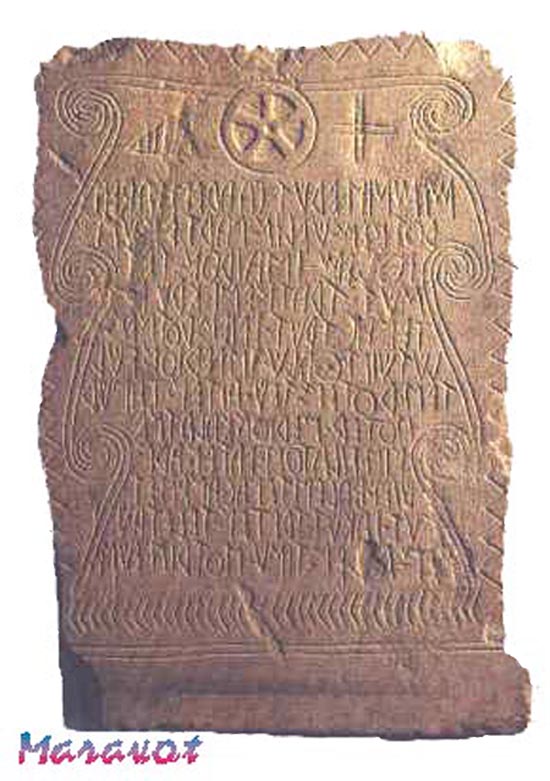
North Picene is an unclassified language from Northeastern Italy, preserved on stelai fragments from the 800-650 BCE period. A quick look at the best preserved inscription, the Novilara Stele, suggests that the language might be IndoEuropean. Other proposals have also been suggested, but this is the one we're to look at today.

The Novilara Stele (6th Century BCE)
mimniś erút gaareśtadeś
rotnem úvlin partenúś
polem iśairon tet
śút tratneši krúviś
tenag trút ipiem rotneš
lútúiś θalú iśperion vúl
teś rotem teú aiten tašúr
śoter merpon kalatne
niś vilatoś paten arn
úiś baleśtenag andś et
šút iakút treten teletaú
nem polem tišú śotriś eúś


For an image of this stele:


And according to this post in this forum:

mimniś erút gaareśtadeś
rotneš úvlin parten úś
polem iśairon tet
šút tratneši krúš
tenag trút ipiem rotneš
lútúiś θalú iśperion vúl
teś rotem teú aiten tašúr
śoter merpon kalatne
niś vilatoś paten arn
úiś baleśtenag andś et
šút lakút treten teletaú
nem polem tišú śotriś eúś

possible alternative readings:
line 1: gaariśtadeś
line 2: partenúś
line 4: krúś
line 5: rotnem
line 8: merion
line 11: mút iakút

And as for the other fragmentary texts, also found in Novilara, according to that forum post:

2nd Stele (left half of two lines)
úpeś
mresveat

The ú in line 1 might also be an L.
In line 2 ve could also be ev or ee.

3rd fragmentary text

pa śatigot
kešoteri
amdet : nk
------ k --------
The p in line 1 is uncertain.

4th fragmentary text
tiperašθe raiup bav---
-----ipš---------------------

I like how the user Arnth also added sidenotes:

"There appears to be some flexion at work: rotnem - rotneš, śoter - śotris.

Similarities to Greek words: polem - polis, śoter - soter, iśperion – esperios."

I noticed this as well, and they're (well at least some of them) transparently IndoEuropean! Though they also note how the -sv- element is also found in North Etruscan, as well as several other features also being possibly Etruscan (so it's not a done deal what language family this belongs to).

Now that we've presented the evidence of this language, let's start picking it apart, shall we?

Sunday, September 14, 2014

Is or Was ProtoIndoEuropean a Split Ergative Language?

I've heard of this theory before, but I never quite gave it much thought. It was seemingly an outdated idea first posited by

I noticed a pattern, one thats relatively easy to see if you lay it out in the form of a table. It seems like animate and inanimate case endings, at least with the nominative case, seem to correspond roughly with what one might expect from a split ergative case pattern. Animate being, or having developed from, an Ergative case; And Inanimate endings being the Absolutive form:
Nominal Endings for the Nominative, Vocative, and Accusative Cases


Animate
Inanimate/Neuter
Singular
Dual
Plural
Singular
Dual
Plural
Nominative
-s/-os
-h₁e /-oh₁e
-es
-Ø/-om
-ih₁/-oih₁
-h₂/-eh₂>-ā
Vocative
-Ø /-ĕ
-h₁e -oh₁e
-es
-Ø/-om
-ih₁/-oih₁
-h₂/-eh₂>-ā
Accusative
-m/-om
-h₁e/-oh₁e
-ns
-Ø/-om
-ih₁/-oih₁
-h₂/-eh₂>-ā
Source: http://en.wikipedia.org/wiki/Proto-Indo-European_nominals

See a pattern?

Now, there are other -h2- forms, of which use -h2- followed by case endings, which I believe could have been seperate case endings. I'm not sure if this table is accurate, its based on the wikipedia article, I was under the impression that neuter endings were seperate from the -h2- endings, which gave rise to the feminine nominal conjugation. I could be wrong, but which it derives from is irrelevant.

This pattern is also seen in Hittite, though with a different set of endings than what wikipedia has for ProtoIndoEuropean:


Animate Nouns
Neuter/Inanimate/Common Nouns
Singular
Plural
Singular
Plural
Nominative
-as
-ēs
-an
-a
Accusative
-an
-us
-an
-a

Notice, that in both instances, the Nominative and Accusative endings for the Neuter/Inanimate are identical. Also, for Animate endings, the two are not identical. Also, outside of the Nominative and Accusative cases, the Animate and Neuter/Inanimate/Common Noun endings are indistinguishable.

This on its own is nothing special, except, we also know that Hittite Neuter nouns can't function as the subject of a transitive verb, rather, their endings must be replaced by Ergative Endings:


Animate
Neuter
Singular
Plural
Singular
Plural
Nominative
-as
-ēs
-an
-a
Ergative
-as
-ēs
-anza
-antēs
Accusative
-an
-us
-an
-a

It's also known that NeoHittite slowly began to confuse Nominative and Accusative Animate plural endings, possibly another indicator of an association between the two. Then again, this easily could be related to the fact that Hittite neighbored and even had a substrate that was an Ergative language. So this need not necessarily be an archaic feature preserved in Hittite.

Its thought that the Ergative case endings for Hittite Neuter nouns originated from a derivationalized form of a suffix -ant-. I'd like to point out that its similar to the Imperfect participle, and 3rd person plural -nt- endings, which are also Active in ProtoIndoEuropean. Perhaps this is the origin of the Ergative case marker?

Active-Nominative Sing. -nt-s>-nz, -nt-es>-entes

The construction seems built upon the animate endings.

A reconstruction of the original paradigm, if ProtoIndoEuropean at some point in its history was a Split Ergative language, it might have looked something like this:

A Possible Reconstruction of ProtoIndoEuropean's Morphosyntactic Case System


Singular
Dual
Plural
Nominative
-Ø/-om
-ih₁/-oih₁
-h₂/-eh₂>-ā
Ergative
-s/-os
-h₁e /-oh₁e
-es
Accusative
-m/-om
-h₁e/-oh₁e
-ns

The beauty of this system is that, the only thing that is lost are the use of "Nominative Dual and Plural" endings to mark the Accusative in Neuter Nouns. As the Neuter paradigm is lost. Though as can be seen from -h2- reconstructions, -h2m can be reconstructed for the Accusative, so all is not really lost.
Also, the Vocative and the Nominative/Oblique, in my view, would have originally been the same case. This makes the Nominative-Vocative very similar to what we find in ProtoUralic, though I can get to the similarities between IE and U in another post. 

For more thoughts on the Ergative Case in PIE:

http://www.kortlandt.nl/publications/art049e.pdf

https://ojs.lib.byu.edu/spc/index.php/DLLS/article/viewFile/31178/29637

https://repozytorium.amu.edu.pl/jspui/bitstream/10593/7433/1/PSiCL_44_4_Bavant.pdf

I realize that there are critics of this theory, but  I don't quite think that the case is closed on Ergativity in PIE; far from it.